Marilyn Monroe’s Personal Payment Documents for Let’s Make Love, 1960
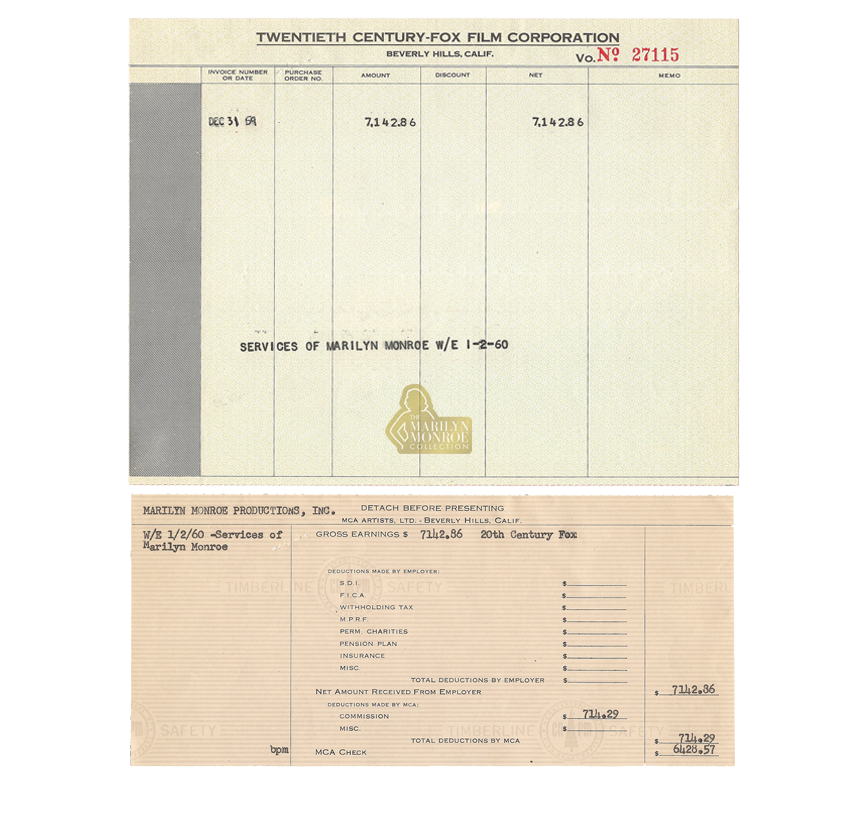
From the Personal Files of Marilyn Monroe: This group of original payment documents consists of check stubs issued by Twentieth Century-Fox Film Corporation and MCA Artists, Ltd., documenting compensation paid for the “Services of Marilyn Monroe” during the week ending January 2, 1960. These records relate directly to Monroe’s work on the Twentieth Century Fox production Let’s Make Love, released later that year.
Check stubs such as these served as the retained financial record of payments issued to Monroe and her representatives, providing precise documentation of her earnings and professional engagements. The involvement of both Twentieth Century Fox and MCA Artists, Ltd., her talent agency, reflects the structured financial and contractual framework through which Monroe’s film work was administered.
At the time these payments were issued, Monroe was one of the most prominent and highly compensated performers in motion pictures. Let’s Make Love represented her return to the screen following the international success of Some Like It Hot and marked an important chapter in her continued career with Twentieth Century Fox.

Preserved among her personal files, these payment documents provide rare, firsthand evidence of Monroe’s professional compensation, offering direct insight into the financial realities of her work as one of the most influential actresses of her era.
Related Cellection Artifacts From the Production of Let’s Make Love, 1960
These payment documents exist within a larger body of surviving artifacts that together document Marilyn Monroe’s work on Let’s Make Love, one of the most significant productions of her later career. Preserved among her personal files and wardrobe are original materials that illustrate both the professional and personal dimensions of Monroe’s involvement in the film.
Central among these is Marilyn Monroe’s personal script for Let’s Make Love, a studio-issued shooting script dated January 15, 1960, personally retained by Monroe and reflecting her direct engagement with the film’s development and production. This working document represents the foundation of her performance as Amanda Dell and preserves the textual framework from which her on-screen work emerged.
Also preserved is an original costume worn by Marilyn Monroe in Let’s Make Love, including a vibrant wool skirt designed by acclaimed costume designer Dorothy Jeakins and bearing its original studio identification label. The garment appears on screen during musical rehearsals and dramatic scenes, providing direct physical continuity between Monroe’s performance and the surviving artifact.
Further documentation of Monroe’s experience during production is found in her personal birthday party receipts from the Let’s Make Love set, which record purchases made for her June 1, 1960 celebration at Twentieth Century Fox. These receipts correspond directly to photographs taken that day, in which the listed items, including refreshments and table settings, are visibly present during the gathering.
Complementing these materials is Marilyn Monroe’s Screen Actors Guild membership card, documenting her active professional standing within the motion picture industry during this period. Such credentials were essential to her continued work in film and reflect the institutional framework within which her career operated.
Together, these related artifacts form a cohesive and verifiable record of Marilyn Monroe’s work on Let’s Make Love. They document the creative, professional, financial, and personal dimensions of the production, offering rare and tangible insight into the lived experience of one of the most important chapters of her career.
Let’s Make Love
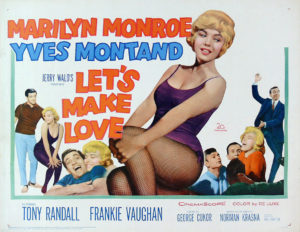
This Cinemascope musical comedy scripted by Norman Krasna as The Billionaire was brought to Marilyn by producer Jerry Wald as Fox stepped up the pressure for her to honor her studio commitments. In 1955 she had agreed to do four films for Fox, but before Let’s Make Love went into production she had only done Bus Stop (1956). Initially Billy wilder was a front runner for the director’s chair. Apparently he was willing to try again after the harrowing experience of working together on Some Like It Hot, but he already was contracted to do The Apartment. George Cukor was summoned as his replacement. He too had difficulties with Marilyn, and reputedly did a great deal of his communication through choreographer Jack Cole.
Marilyn’s reputation made it next to impossible to find a male lead for this movie, a character rumored to be closely modeled after Howard Hughes. Before Yves Montand was offered the role, it was turned down by a “who’s who” of Hollywood’s headliners: Yul Brenner, Cary Grant, Rock Hudson, Charlton Heston, William Holden, Gregory Peck, and James Stewart. It was Marilyn who suggested Montand; the studio was not happy, but she insisted, and Marilyn got her man, in more ways than one. Their very public love affair spelled the beginning of the end of Marilyn’s marriage to Arthur Miller, and came close to unraveling Montand’s union with Simone Signoret.
There were script troubles too. Miller returned from Ireland, where he had been working with John Huston on the script for The Misfits, to do some emergency work on Let’s Make Love. “Before production, I did some rewriting of a couple of scenes. I tried to give some point between these two featureless figures. When they talked, there was no character, no motivation, and so I stepped in and did what I could for the script. But we were beating a dead horse.”
The biggest delays during filming were not due to Marilyn’s lateness or illness, they were because of a strike by actors to preserve residual payments. The Writers Guild came out in support too, though this was precisely at the time when Arthur was doing the rewrites.
Marilyn sang four songs for the film: My Heart Belongs to Daddy by Cole Porter, and Let’s Make Love, Incurably Romantic, and Specialization by Sammy Cahn and James Van Heusen. Marilyn’s rendition of My Heart Belongs to Daddy is remarkable for the effortlessness of her performance, the result of at least two weeks of rehearsal.
The movie bombed. Critical write-ups were almost all scathing, and the public stayed away. Inside Hollywood, gossip circulated that Marilyn’s star was on the wane. Outside America, the film was renamed The Millionaire.
Collector’s Note
These payment documents provide direct and verifiable evidence of Marilyn Monroe’s professional compensation during the production of Let’s Make Love. Issued by Twentieth Century Fox and her agency, MCA Artists, Ltd., they reflect the formal contractual and financial structure supporting her work.
At the time, Monroe stood at the height of her career, having achieved international acclaim and recognition as one of the most influential figures in motion pictures. These records document the tangible financial acknowledgment of her talent and professional contributions.
Preserved among her personal files, these check stubs serve as important historical artifacts, providing rare insight into the business realities of Marilyn Monroe’s career and the professional systems that supported her enduring legacy.

Scott Fortner
Marilyn Monroe Collection
Founder & Owner

@mariylnmonroecollection 

TheMarilynMonroeCollection