
Letter to Marilyn Monroe From Film Executive Matthew Fox
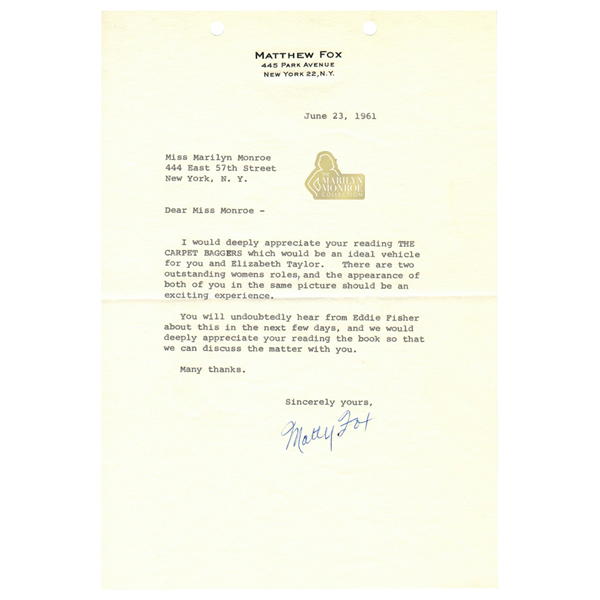
This typed letter, dated June 23, 1961, was sent to Monroe at her apartment at 444 East 57th Street in New York by film executive Matthew “Matty” Fox, written on his personal stationery at 445 Park Avenue. It proposes Monroe for a role in a film adaptation of Harold Robbins’ novel The Carpetbaggers, alongside Elizabeth Taylor.
Fox describes the project as “an ideal vehicle” for both women, noting two outstanding female roles and suggesting their appearance together on screen “should be an exciting experience.” He indicates that Eddie Fisher, then Taylor’s husband, would be following up with Monroe directly.
Neither Monroe nor Taylor appeared in the film. The Carpetbaggers was produced in 1964 with Carroll Baker in the female lead. Monroe died in August 1962. Matty Fox died in June 1964, weeks before the film’s release.
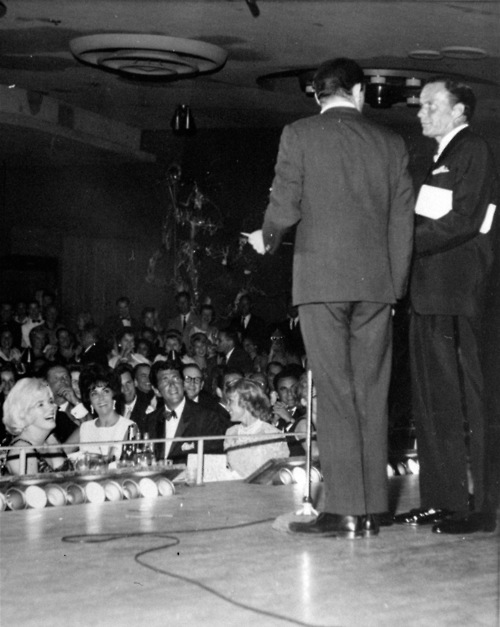
Notably, just weeks before this letter was written, Monroe and Taylor had been photographed together in Las Vegas on June 7, 1961, alongside Dean Martin at Frank Sinatra’s performance at the Sands Hotel. Fox would have been aware of that public pairing.
Matthew Fox
Matthew “Matty” Fox was one of the most significant behind the scenes figures in mid century Hollywood. As executive vice president of Universal Pictures, he later pioneered the syndication of films to television through his company Motion Pictures for Television. In 1955 he made his most consequential move, purchasing the entire RKO Radio Pictures library, 740 features and over 1,000 short subjects, for distribution to television stations nationwide. He also introduced pay television to the United States through his Skiatron of America company.
His letter to Monroe in June 1961 places her within the serious business conversation of the industry, not simply as a performer being courted by a studio, but as someone the major independent dealmakers were approaching directly with significant projects.
Collector’s Note
The letter is straightforward in what it documents. A significant Hollywood executive writing directly to Monroe, proposing a pairing with Elizabeth Taylor in one of the most anticipated literary adaptations of the decade. The approach was personal and direct — his own stationery, his own signature, a request that she read the book.
What the letter could not have anticipated is what followed. Monroe died fourteen months later. Fox died three years after that, weeks before the film he had tried to build around her was released. The collaboration he proposed never happened, and the circumstances that prevented it were not yet in motion when he signed the letter.
That gap between intention and outcome is what makes correspondence like this worth preserving. It is a document of possibility, written at a moment when everything it proposed still seemed entirely reasonable.

Scott Fortner
Marilyn Monroe Collection
Founder & Owner

@mariylnmonroecollection 

TheMarilynMonroeCollection