
Letter to Marilyn Monroe from Attorney Milton Rudin
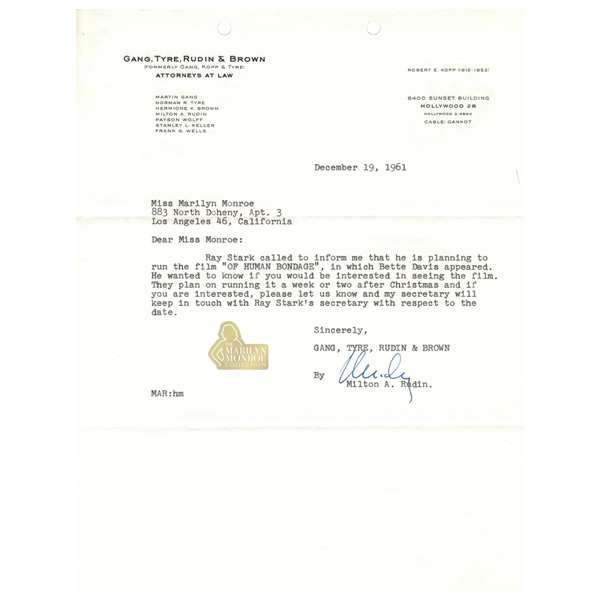
This original letter, dated December 19, 1961, was sent to Marilyn Monroe by her attorney Milton A. Rudin of the law firm Gang, Tyre, Rudin & Brown and preserved among her personal files. Addressed to Marilyn at her residence on North Doheny Drive in Los Angeles, the correspondence concerns a private screening invitation extended through film producer Ray Stark.
In the letter, Rudin informs Marilyn that Ray Stark had arranged a screening of the motion picture Of Human Bondage, starring Bette Davis, and wished to know whether Marilyn would be interested in attending. Rudin offers to coordinate directly with Stark’s office should she accept the invitation.
The reference to Of Human Bondage is particularly notable. Bette Davis’s performance in the 1934 film adaptation of W. Somerset Maugham’s novel was widely regarded as one of the most powerful dramatic performances in cinema history. Invitations such as this reflect Marilyn’s continued engagement with serious dramatic work and her ongoing relationships with leading producers, including Ray Stark, who would later produce major Hollywood films.
Preserved on official law firm letterhead and signed by Rudin, this artifact provides rare documentary evidence of the professional guidance Marilyn Monroe received and the continued interest of major industry figures in her participation and presence. It reflects both her stature within the film community and the careful legal and professional oversight that shaped her career during its final chapter.
Milton A. Rudin
Milton A. Rudin was Marilyn Monroe’s attorney during the final years of her life and served as one of her most important legal advisors as she navigated her career with increasing independence. A partner in the Los Angeles law firm Gang, Tyre, Rudin & Brown, Rudin represented Marilyn in a range of professional matters, including contracts, negotiations, and communications with producers, studios, and industry executives.
By 1961, Marilyn had returned to Los Angeles following her divorce from Arthur Miller and was living at 883 North Doheny Drive. During this period, Rudin acted as a central point of contact between Marilyn and major figures in the motion picture industry. His correspondence with her, preserved among her personal files, reflects his role in presenting film opportunities, coordinating meetings, and protecting her legal and professional interests.
Rudin’s involvement came at a pivotal moment in Marilyn’s career. Having established Marilyn Monroe Productions in 1955, she had moved beyond the traditional studio contract system and required careful legal representation to evaluate independent film offers, television projects, and production agreements. Attorneys such as Rudin played a critical role in ensuring that her contractual rights, financial interests, and creative autonomy were protected.
His letters to Marilyn also demonstrate the level of access and respect she commanded within the industry. Producers and executives often communicated with her through Rudin, underscoring his trusted position within her professional circle. Preserved correspondence from Rudin provides important documentary evidence of the legal and business infrastructure that supported Marilyn Monroe during the final phase of her life and career.
Ray Stark
Ray Stark was one of the most influential and successful film producers in Hollywood during the mid twentieth century. As founder of Seven Arts Productions and later Rastar Productions, he was responsible for producing a number of major motion pictures and played an important role in shaping American cinema during the 1950s, 1960s, and beyond.
Stark began his career as a literary agent and talent representative before transitioning into film production. He became closely associated with author W. Somerset Maugham and was instrumental in adapting literary works for the screen. His early producing credits included films based on Maugham’s writings, establishing his reputation for bringing sophisticated dramatic material to motion pictures.
By the early 1960s, Stark was actively developing and producing major film projects and maintained professional relationships with leading actors and actresses, including Marilyn Monroe. His invitation to Marilyn Monroe to attend a private screening of Of Human Bondage, conveyed through her attorney Milton Rudin in December 1961, reflects the continued interest of prominent producers in her and her standing within the industry during the final year of her life.
Stark would go on to produce numerous acclaimed and commercially successful films, including Funny Girl (1968), starring Barbra Streisand, and its sequel Funny Lady (1975). Over the course of his career, he earned multiple Academy Award nominations and established himself as one of Hollywood’s most respected producers.
His documented correspondence with Marilyn Monroe provides important historical evidence of the professional network surrounding her and the continued opportunities presented to her by leading figures in the motion picture industry.
Collector’s Note
Letters from Milton Rudin represent an important part of Marilyn Monroe’s professional archive, documenting the legal and business oversight that supported her independent career. Correspondence such as this provides insight into the film industry relationships and opportunities presented to her during the final years of her life. Preserved among her personal papers, the letter reflects Marilyn Monroe’s continued importance within Hollywood and the trusted advisors who represented her interests.

Scott Fortner
Marilyn Monroe Collection
Founder & Owner

@mariylnmonroecollection 

TheMarilynMonroeCollection