
Letter to Marilyn Monroe from Fox Executive Frank H. Ferguson
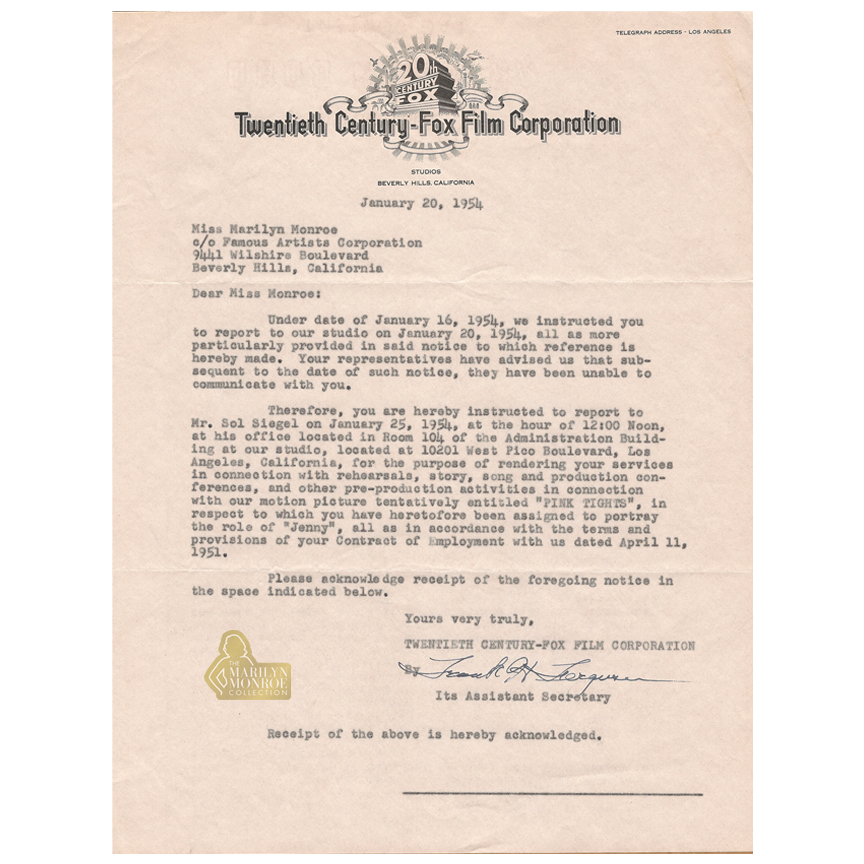
A Twentieth Century Fox Letter to Marilyn Monroe Regarding Pink Tights
January 20, 1954
This original studio letter, sent to Marilyn Monroe by Twentieth Century Fox Film Corporation on January 20, 1954, documents a pivotal and transitional moment in her early career. Written on official Fox studio letterhead and addressed to Marilyn in care of Famous Artists Corporation at 9441 Wilshire Boulevard in Beverly Hills, the letter formally instructs her to report to the studio for pre production work on a planned musical film tentatively titled Pink Tights. It was signed by Frank H. Ferguson, a Fox executive.
The letter directs Marilyn to meet with studio executive Sol Siegel on January 25, 1954, at the Fox studios located at 10201 West Pico Boulevard in Los Angeles. She was assigned to portray a character named “Jenny,” and the notice outlines her obligation to participate in rehearsals, story conferences, song preparation, and other pre production activities in accordance with the terms of her Fox employment contract dated April 11, 1951.
This correspondence reflects Marilyn’s continued contractual relationship with Twentieth Century Fox during a period when she was rapidly emerging as one of the studio’s most valuable and visible stars. Although she had achieved major success in films such as Niagara, Gentlemen Prefer Blondes, and How to Marry a Millionaire in 1953, she remained contractually bound to the studio system, which exercised substantial control over her assignments.
Contemporary press coverage confirms Fox’s plans for the production. A newspaper article published at the time reported that Marilyn would portray a schoolteacher in the musical Pink Tights, reflecting the studio’s intent to cast her in another musical role that would capitalize on her growing popularity and screen presence.
Despite these preparations, Pink Tights was never produced. The project was ultimately abandoned as Marilyn’s relationship with Twentieth Century Fox became increasingly strained. Within months of this letter, she would suspend her film work and travel to New York in late 1954 and study at the Actors Studio in 1955, marking the beginning of her transformation from studio contract player to independent artist.
Today, this letter stands as an important documentary record of Marilyn Monroe’s evolving career during the height of the Hollywood studio system. It reflects both the studio’s plans for her future and the contractual obligations that shaped her professional life during this formative period. Preserved as part of her personal and professional archive, the letter provides rare insight into the production planning, studio control, and unrealized projects that defined Hollywood in the 1950s.
Frank H. Ferguson
Frank H. Ferguson served as Assistant Secretary of Twentieth Century Fox Film Corporation during the early 1950s, a senior administrative and legal position within the studio’s corporate structure. In this role, Ferguson was responsible for issuing official studio correspondence, including employment notices, contractual directives, and formal communications to actors under contract, including Marilyn Monroe.
As Assistant Secretary, Ferguson operated within the studio’s executive and legal chain of authority, working under the direction of Twentieth Century Fox’s corporate officers and legal department. His duties included preparing and signing documents that carried legal force under the terms of the studio’s employment agreements. These letters were not personal communications, but official corporate notices representing the authority of Twentieth Century Fox itself.
Ferguson’s correspondence with Marilyn Monroe reflects the contractual control the studio exercised over her during the early years of her career. Letters signed by Ferguson formally instructed Marilyn to report for rehearsals, meetings, and pre production activities, including her assignment to the planned motion picture Pink Tights in January 1954. Such notices were issued pursuant to the terms of her April 11, 1951 employment contract, under which the studio had the legal right to assign her roles and require her participation in productions.
His position illustrates the structured corporate hierarchy that governed Hollywood during the studio system era. Administrative officers such as Ferguson acted as the formal legal voice of the studio, ensuring that contractual obligations were enforced and documented.
Today, Frank H. Ferguson’s signed correspondence provides important historical evidence of the professional and legal framework within which Marilyn Monroe worked. These documents help illuminate the institutional structure that shaped her early career and underscore the degree of studio control she would later challenge as she asserted her independence and established Marilyn Monroe Productions.
Collector’s Note
Studio correspondence such as this demand letter represents an important documentary record of Marilyn Monroe’s contractual relationship with Twentieth Century Fox during a pivotal moment in her rise to stardom. Sent in January 1954, the letter formally assigned her to report for pre production on Pink Tights, reflecting the studio’s authority to direct her professional activities under the terms of her contract.
Particularly significant is the fact that Pink Tights was never produced. As an unrealized project, the letter preserves evidence of roles Marilyn Monroe was intended to perform but ultimately did not, offering rare insight into the studio’s plans for her career and the production decisions that shaped her trajectory.
Artifacts of this nature provide valuable historical context, documenting both the opportunities presented to Marilyn Monroe and the constraints imposed by the Hollywood studio system. Preserved within her personal archive, this correspondence stands as an authentic record of her professional life at a turning point, just prior to her break from the studio and her emergence as an independent artist.

Scott Fortner
Marilyn Monroe Collection
Founder & Owner

@mariylnmonroecollection 

TheMarilynMonroeCollection