
Marilyn Monroe’s Personal Newspaper Clippings

A sizeable collection of press clippings from various publications printed during the summer months of 1961, all with red wax pencil marks indicating references to Marilyn Monroe; from her own collection. Monroe likely paid a service to “clip and highlight” for her as was common practice for celebrities.
Marilyn Monroe in the Press, Summer of 1961
The newspaper clippings preserved here document how Marilyn Monroe was being reported on in August 1961.
Much of the coverage centers on public sightings with Joe DiMaggio. Multiple columns note that Marilyn and DiMaggio were seen together in Los Angeles and Lake Tahoe, prompting speculation about renewed closeness following her divorce from Arthur Miller earlier that year. Louella Parsons reports that Marilyn appeared slim and in good health, describing her in a pale blue gown and quoting her as saying she was “just resting” and “trying to get my health back.”
Other items reference DiMaggio stopping in Hollywood to see Marilyn while traveling to San Francisco, reinforcing the narrative circulating in entertainment columns at the time.
Beyond relationship reporting, one radio and television brief announces that Marilyn would narrate a filmed tour of military installations during the Korean War for NBC, confirming continued professional activity during this period.
Additional mentions appear within industry coverage, including references in Variety and Hollywood trade columns that situate her within the broader entertainment community and ongoing Actors Studio associations.
Taken together, these clippings reflect the intersection of personal speculation, social reporting, and professional updates that characterized Marilyn Monroe’s press coverage in the summer of 1961.
From Marilyn Monroe’s Personal Trunk Packed In 1961
These press clippings are part of several personal items Marilyn Monroe placed into her trunk during her final visit to the Monroe Miller farm in Roxbury, Connecticut, in the summer of 1961, following her divorce from Arthur Miller.
Accompanied by Ralph Roberts and her half sister Berniece Miracle, Marilyn gathered deeply personal possessions that Roberts later described as containing “her past.” These objects, ranging from childhood keepsakes to books and personal archives, were carefully preserved by Marilyn at a moment of profound transition in her life.
From the memoirs of Ralph Roberts:
July 12, 1961
MM wanted one last trip to Roxbury to pick up various items, mainly kitchen stuff. Things she gave me included an aluminum orange squeezer, percolator, etc.
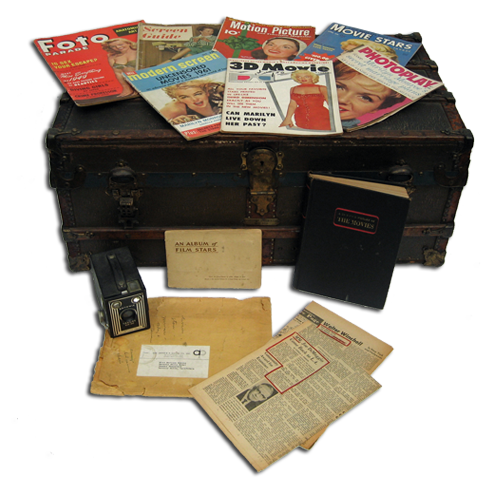
Also a footlocker of odds and ends from as she said “her past.” This footlocker contained various things – a Brownie from her Aunt Ana “only it’s black.” She had discussed with Richard Avedon his taking a picture of her taking a picture of him with it. He thought it an idea, but they never got around to it.
Each item from the trunk represents not only an individual artifact, but part of a larger historical narrative. Together, they form one of the most intimate surviving records of Marilyn Monroe’s personal history. Several artifacts from that trip are part of The Marilyn Monroe Collection today:
- Marilyn’s first Kodak Brownie camera
- Marilyn’s personal film and gossip magazine collection
- Marilyn’s childhood Album of Film Stars
- Marilyn’s childhood Film History Book
Note that Marilyn’s trunk itself is also part of The Marilyn Monroe Collection. Click here.
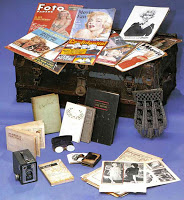
The 1995 Christie’s Auction
Among the First Marilyn Monroe Artifacts Ever Offered to the Public
Marilyn Monroe’s trunk and its contents hold an important place not only in her personal history, but in the history of Marilyn Monroe artifact preservation and collecting.
In 1995, the trunk and its contents were offered at auction by Christie’s East. This sale occurred four years before the landmark 1999 Christie’s auction, The Personal Property of Marilyn Monroe, which would later bring global attention to her personal belongings and establish the modern market for Marilyn Monroe artifacts.
At the time of the 1995 auction, very few authenticated personal possessions belonging directly to Marilyn Monroe had ever been made available to the public. The offering of her trunk and its contents represented one of the earliest opportunities for collectors, historians, and institutions to acquire objects that Marilyn Monroe had personally owned, used, and preserved.
Unlike later auctions, which included wardrobe, jewelry, and studio related material, the trunk contained deeply personal items that Marilyn herself had deliberately gathered and kept. These were not objects selected by studios, agents, or estate administrators. They were objects Marilyn chose to save.
The trunk and its contents offered a rare and intimate glimpse into Marilyn Monroe’s private life, containing childhood possessions, books, personal archives, and keepsakes that had accompanied her across decades.
Their appearance at Christie’s in 1995 marked the beginning of the modern era of Marilyn Monroe collecting.
Today, these artifacts stand among the earliest Marilyn Monroe personal effects ever to enter the public record through auction, predating the historic 1999 Christie’s sale that would later define her global auction legacy.
Entertainment Memorabilia Auction
June 24, 2004


Collector’s Note
The summer of 1961 was not an easy period for Monroe. She had recently finalized her divorce from Arthur Miller, had been hospitalized at Payne Whitney and later Columbia Presbyterian, and was in the process of reorienting her professional and personal life. These clippings were gathered during that stretch.
What the red wax pencil marks tell us is that she was reading this coverage actively, not filing it away unexamined. The columns being tracked were largely focused on her relationship with DiMaggio and her physical appearance, the kind of reporting that flattened a complicated period in her life into social gossip. She was aware of that narrative and appears to have been monitoring it.
That these clippings ended up in the trunk she packed at Roxbury places them in a specific category of objects she considered worth preserving. She was not saving them as memorabilia. She was saving them as a record.

Scott Fortner
Marilyn Monroe Collection
Founder & Owner

@mariylnmonroecollection 

TheMarilynMonroeCollection