
Marilyn Monroe Childhood Photographs Annotated in Her Hand
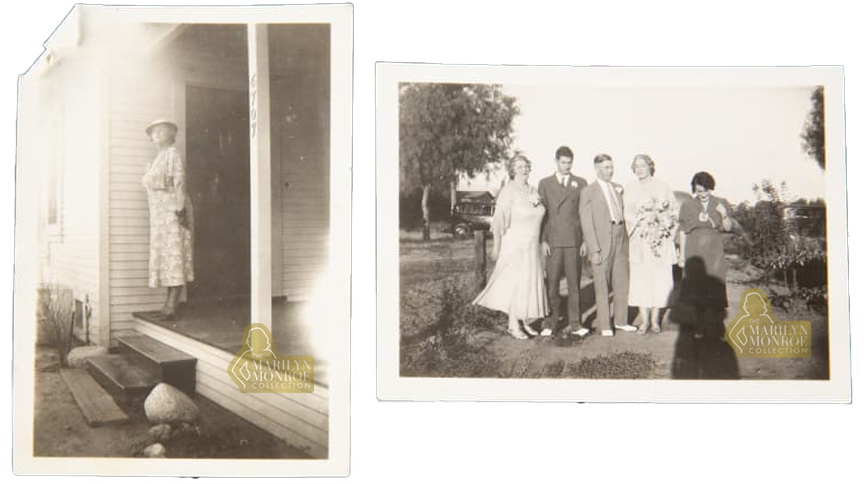
These two original photographs date to circa 1942 to 1944, when Marilyn Monroe was still known as Norma Jeane. Both images come directly from her personal collection and are made especially significant by Marilyn’s handwritten annotations on their reverse, identifying the individuals and preserving the moments they represent.
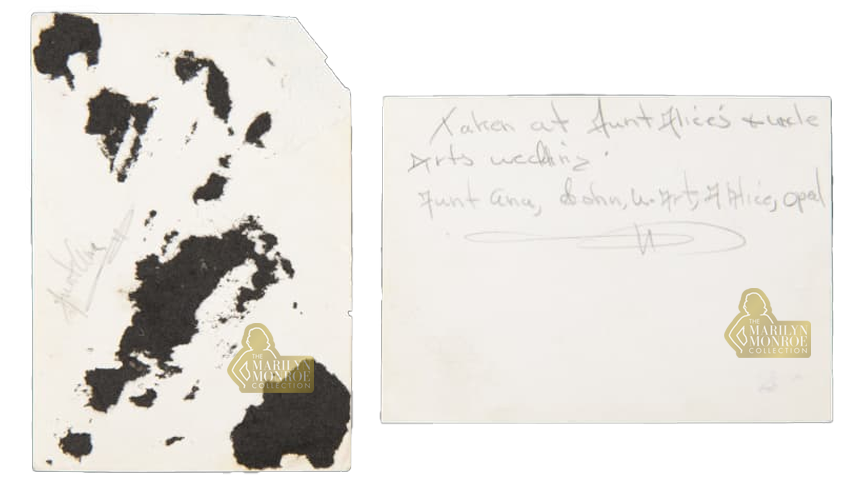
The first photograph shows Aunt Ana standing outside her home at 6707 Odessa Avenue in Van Nuys, California. On the reverse, Marilyn wrote simply, “Aunt Ana,” confirming the subject’s identity. Ana was the paternal aunt of Grace Goddard, who served as Norma Jeane’s legal guardian during much of her youth. Through Grace, Norma Jeane became part of an extended family network that provided care and stability during a childhood marked by frequent moves and uncertainty.
The second photograph depicts a family wedding. Marilyn carefully identified the occasion and individuals in pencil, writing: “Taken at Aunt Alice’s & Uncle Art’s wedding / Aunt Ana, John, U. Art, A. Alice, Opal.” Her annotation preserves not only the event itself but also the identities of the family members present, reflecting her personal connection to them.
Aunt Ana held particular importance in Norma Jeane’s early life. She was part of the family circle that surrounded Norma Jeane during her formative years, and she also gave Norma Jeane a Brownie camera. That camera, now preserved in The Marilyn Monroe Collection, represents one of Marilyn’s earliest personal possessions and connects directly to the same family relationship documented in these photographs.
Collector’s Note
Marilyn identified both photographs herself, writing on the reverse to name Aunt Ana and document a family wedding. That handwriting is what distinguishes them. It places these images directly in her hands and confirms they mattered enough to preserve and annotate.
Aunt Ana was a stable presence during an unstable childhood. Her Brownie camera, also part of this collection, came from that same relationship.
These are not glamour photographs or professional portraits. They are family records, handled and identified by Marilyn in her own hand, from a period of her life that is rarely this directly documented.
These photographs are rare survivals from Marilyn Monroe’s childhood. More importantly, they were preserved and personally identified by Marilyn herself, providing direct evidence of the people and relationships that formed part of her earliest life. Through her own handwriting, Marilyn ensured that these individuals and moments would remain remembered.

Scott Fortner
Marilyn Monroe Collection
Founder & Owner

@mariylnmonroecollection 

TheMarilynMonroeCollection