
Marilyn Monroe’s Personal Laundry Receipts Providing Documentary Context to Death Scene Claims
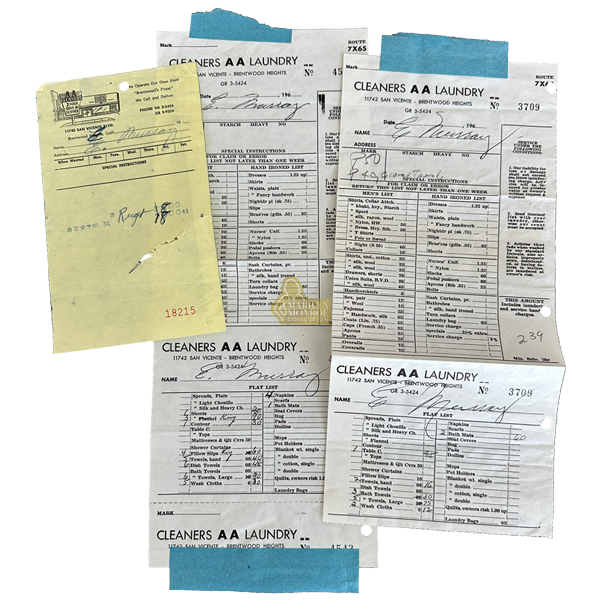
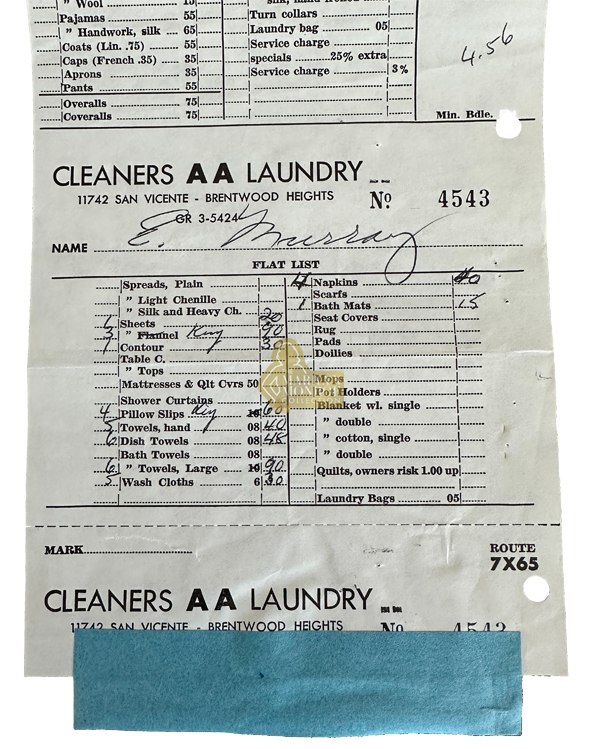
From the Personal Files of Marilyn Monroe: A group of original laundry receipts from Cleaners A A Laundry in Brentwood Heights, documenting routine household services performed for Marilyn Monroe during her residence at 12305 Fifth Helena Drive in 1962. The receipts itemize the professional cleaning of domestic textiles including towels, bath mats, wash cloths, and bed sheets.
One receipt is especially significant because it clearly records the laundering of sheets. This provides direct administrative verification that Monroe relied on an external laundry service for the washing of her bedding. The repeated presence of similar receipts suggests that this was not an isolated occurrence but part of an established household routine.
Cleaners A A Laundry operated on a neighborhood collection and delivery route serving Brentwood residents. Monroe’s use of the service reflects a practical domestic structure in which household maintenance was handled through outside providers rather than exclusively within the home itself.
No verified documentation has surfaced indicating that Monroe’s Brentwood residence contained a washing machine. The survival of these receipts therefore contributes important factual context when evaluating later narratives about the circumstances of her death.
In accounts published more than a decade after Monroe’s passing, former Los Angeles Police Department officer Jack Clemmons introduced claims that housekeeper Eunice Murray was doing laundry inside the home during the early morning hours of August 5 1962. Clemmons further suggested that Monroe’s bedroom appeared staged and that the presence of laundry activity was connected to efforts to conceal evidence. These assertions were not included in his original police report and were first introduced in retrospective interviews and publications during the mid 1970s.
Subsequent writers repeated and expanded these claims, often presenting them as established fact. Over time, the idea that sheets were being washed in the house became intertwined with broader murder conspiracy theories, including speculation that Monroe’s death involved physical circumstances requiring the removal or cleaning of bedding.
The existence of Monroe’s documented reliance on professional laundry services does not resolve every question surrounding her final hours. However, it provides concrete evidence of how routine domestic tasks were normally handled. These records demonstrate that sending linens out for cleaning was consistent with her established practice.
Preserved among Monroe’s personal papers, the receipts transform a seemingly ordinary household transaction into a historically meaningful document. They offer measurable insight into daily life at the Brentwood residence and introduce primary evidence into discussions that have long relied on retrospective interpretation.
Collector’s Note
As a collector and historian, I am particularly drawn to documents that clarify lived reality rather than reinforce narrative.
These laundry receipts are compelling because they intersect directly with later claims about the events surrounding Marilyn Monroe’s death. The suggestion that laundry was being done inside the home emerged years after the fact and became part of a larger framework of speculation.
What these receipts show is not theory, but practice. They demonstrate that Monroe routinely relied on an external service for the cleaning of household linens, including sheets. In doing so, they provide a factual reference point that helps evaluate the plausibility of later recollections.
Artifacts like these do not exist to settle debate. Their value lies in grounding discussion in documented behavior. For those seeking to understand Marilyn Monroe’s final months, administrative records such as these offer a level of clarity that memory and interpretation often cannot.

Scott Fortner
Marilyn Monroe Collection
Founder & Owner

@mariylnmonroecollection 

TheMarilynMonroeCollection