
Marilyn Monroe’s Personal Kodak Brownie Target Six 20 Camera
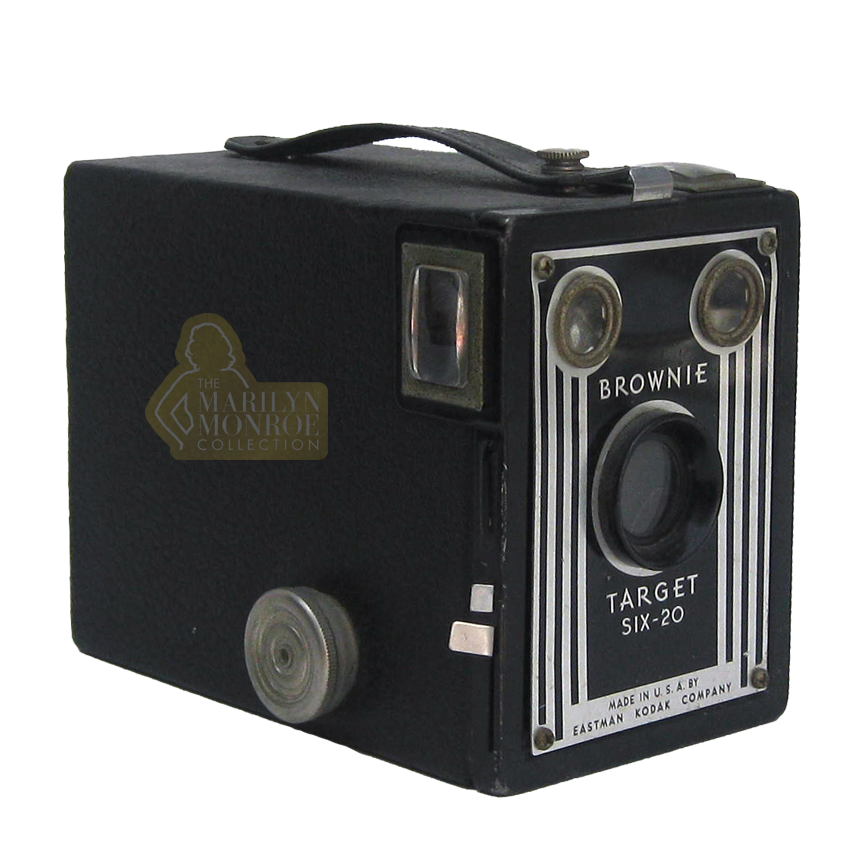
Marilyn Monroe’s first camera, a Brownie Target Six-20 manufactured by the Eastman Kodak Company, was personally owned by Marilyn and packed into a trunk with other belongings as she prepared to leave her Roxbury, Connecticut home during the dissolution of her marriage to Arthur Miller.
In 1961, Ralph Roberts, Marilyn’s masseur, accompanied Marilyn and her half sister Berniece Miracle to the former Miller Monroe country home in Roxbury to retrieve her remaining personal effects. Among the items gathered during that visit was this camera, a quiet but meaningful artifact from an earlier chapter of her life.
Marilyn later told photographer Richard Avedon that the Brownie had been a gift from her Aunt Ana, adding a personal layer to its provenance and underscoring its place within her early family life. Ana Lower was one of the most stabilizing figures in Marilyn’s early life, caring for her during part of her childhood and remaining a meaningful presence well into her adolescence. By the time Ana died in 1948, Marilyn had already signed her first film contract with 20th Century Fox in 1946 and was beginning her transformation into Marilyn Monroe.

The Brownie Target Six 20
The Brownie Target Six 20 was part of Kodak’s immensely popular Brownie line, a series of affordable, easy to use cameras designed to bring photography into ordinary American homes. Constructed of molded Bakelite with a simple meniscus lens and fixed focus, the camera was built for accessibility rather than technical precision. It used 620 roll film and produced square format images, allowing amateur photographers to document everyday life with remarkable ease.
The Brownie line revolutionized personal photography in the twentieth century by making cameras inexpensive and straightforward to operate. Families, young couples, and children could now create their own visual histories. In this context, Marilyn’s ownership of a Brownie Target Six 20 is especially poignant. Long before she became one of the most photographed women in the world, she held in her hands a device meant to capture her own memories.
Preserved today as part of The Marilyn Monroe Collection, this camera represents more than a utilitarian object. It stands as a reminder that before she became a global icon, Marilyn Monroe was also the observer behind the lens, recording moments of her own life.
From Marilyn Monroe’s Personal Trunk Packed In 1961
This camera is part of several personal items Marilyn Monroe placed into her trunk during her final visit to the Monroe Miller farm in Roxbury, Connecticut, in the summer of 1961, following her divorce from Arthur Miller.
Accompanied by Ralph Roberts and her half sister Berniece Miracle, Marilyn gathered deeply personal possessions that Roberts later described as containing “her past.” These objects, ranging from childhood keepsakes to books and personal archives, were carefully preserved by Marilyn at a moment of profound transition in her life.
From the memoirs of Ralph Roberts:
July 12, 1961
MM wanted one last trip to Roxbury to pick up various items, mainly kitchen stuff. Things she gave me included an aluminum orange squeezer, percolator, etc.
Also a footlocker of odds and ends from as she said “her past.” This footlocker contained various things – a Brownie from her Aunt Ana “only it’s black.” She had discussed with Richard Avedon his taking a picture of her taking a picture of him with it. He thought it an idea, but they never got around to it.
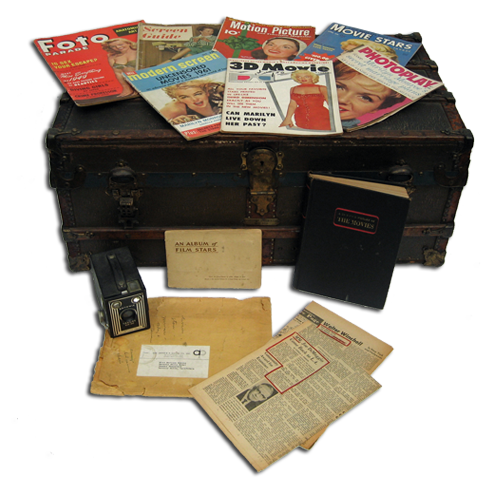
Each item from the trunk represents not only an individual artifact, but part of a larger historical narrative. Together, they form one of the most intimate surviving records of Marilyn Monroe’s personal history. Several artifacts from that trip are part of The Marilyn Monroe Collection today:
- Marilyn’s personal film and gossip magazine collection
- Marilyn’s childhood Album of Film Stars
- Marilyn’s childhood Film History Book
- Marilyn Monroe’s Personal Newspaper Clippings
Note that Marilyn’s trunk itself is also part of The Marilyn Monroe Collection. Click here.
The 1995 Christie’s Auction
Among the First Marilyn Monroe Artifacts Ever Offered to the Public
Marilyn Monroe’s trunk and its contents hold an important place not only in her personal history, but in the history of Marilyn Monroe artifact preservation and collecting.
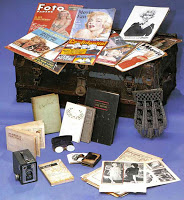
In 1995, the trunk and its contents were offered at auction by Christie’s East. This sale occurred four years before the landmark 1999 Christie’s auction, The Personal Property of Marilyn Monroe, which would later bring global attention to her personal belongings and establish the modern market for Marilyn Monroe artifacts.
At the time of the 1995 auction, very few authenticated personal possessions belonging directly to Marilyn Monroe had ever been made available to the public. The offering of her trunk and its contents represented one of the earliest opportunities for collectors, historians, and institutions to acquire objects that Marilyn Monroe had personally owned, used, and preserved.
Unlike later auctions, which included wardrobe, jewelry, and studio related material, the trunk contained deeply personal items that Marilyn herself had deliberately gathered and kept. These were not objects selected by studios, agents, or estate administrators. They were objects Marilyn chose to save.
The trunk and its contents offered a rare and intimate glimpse into Marilyn Monroe’s private life, containing childhood possessions, books, personal archives, and keepsakes that had accompanied her across decades.
Their appearance at Christie’s in 1995 marked the beginning of the modern era of Marilyn Monroe collecting.
Today, these artifacts stand among the earliest Marilyn Monroe personal effects ever to enter the public record through auction, predating the historic 1999 Christie’s sale that would later define her global auction legacy.
Film and Television Memorabilia Auction
December 18, 1995
Collector’s Note
Marilyn identified this camera herself. When Ralph Roberts documented the contents of her trunk in July 1961, she told him the Brownie had come from Aunt Ana. That attribution is part of the object’s record.
What I find most interesting about this piece is the inversion it represents. Marilyn Monroe is among the most photographed people of the twentieth century. This is the camera she owned before any of that, a basic, inexpensive Brownie given to her as a girl, kept for years, and packed deliberately when she was closing a chapter of her life. She held onto it for a reason.
The camera and the family photographs she annotated, also in this collection, come from the same period and the same relationship. Together they form a small but unusually direct record of her life as Norma Jeane.

Scott Fortner
Marilyn Monroe Collection
Founder & Owner

@mariylnmonroecollection 

TheMarilynMonroeCollection