
Invitation to Marilyn Monroe from Mrs. Harry Brand

A personal invitation to join the founding members of the exclusive Hollywood Museum Associates Board of Directors.
“The Hollywood Museum Associates Board of Directors extends to Marilyn Monroe the honor to become one of the founder members, and to enjoy the full privileges of its association with the County of Los Angeles Hollywood Motion Picture and Television Museum.”
Also present are two typed related notes with handwritten notations, one being in Marilyn’s own hand. The first handwritten note on an insert with the invitation reads, “Dear Marilyn, Do so hope you will join this exciting project- Fondly, Sybil-” Sybil being Sybil Brand, wife of Harry Brand, longtime head of publicity for 20th Century Fox.
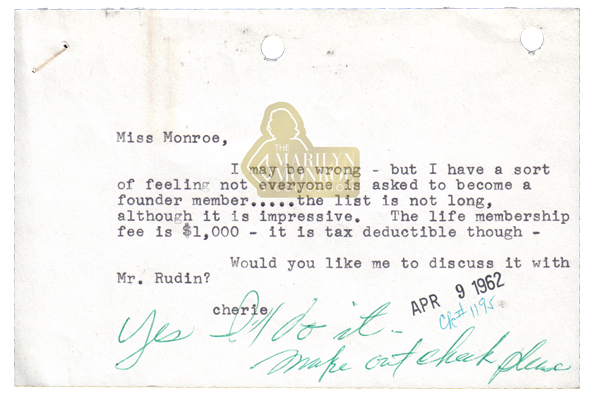
The second note is a message from Cherie Redmond, Marilyn’s last secretary from January, 1962 until her death. This note to Marilyn reads, “Miss Monroe, I may be wrong – but I have a sort of feeling not everyone is asked to become a founder member…..the list is not long, although it is impressive. The life membership fee is $1,000 – it is tax deductible though – Would you like me to discuss it with Mr. Rudin? cherie” Mr. Rudin being Marilyn’s attorney. To which Marilyn responds in her own hand, “Yes I’ll do it – Make out check please”
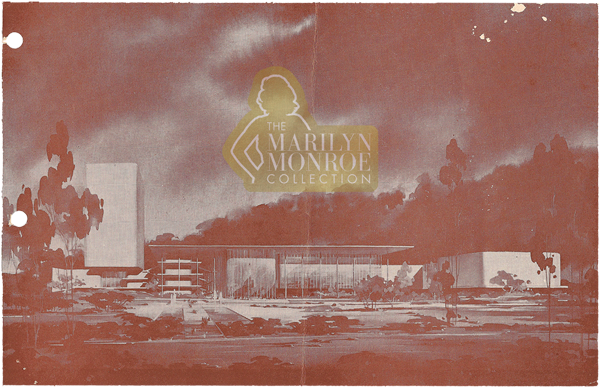
Also included with the invitation to Marilyn was an architectural rendered image of the museum.
Cherie Redmond
From the book Marilyn: The Last Months by Eunice Murray: While she was in Mexico City buying paintings for her home, Marilyn had a difficult time choosing between two similar oils of an adobe house at twilight. One had a light in the window; the other did not. It seemed strange that she hesitated so long before deciding on the painting with the light. “This one looks lived in,” she said at last. “It has so much more warmth.” If this symbolized a hesitancy to dare to dream of a warm home life of her own, by spring and summer of 1962, the decision was made, Marilyn allowed herself a light in the window. But only for her friends. The new sanctuary must not be violated by people she felt out of harmony with. This fact became very clear to Eunice when she heard about the new business secretary Marilyn’s attorney had hired.
“She must never be allowed in my home.”
“She must never be allowed in my home,” Marilyn told Eunice in Mexico City. Marilyn and her secretary had traveled to New York together the week before the Mexican trip to arrange for business files to be sent to Twentieth Century-Fox. They had stayed together in Marilyn’s New York apartment, and then the clash in personalities had arisen. “Mr. Rudin says she’s a good secretary, and I guess she is,” Marilyn said. “But she can’t be one of my close friends.”
Marilyn’s reaction had been adverse from the moment she heard her name from the attorney. “Cherie?” Marilyn had said on the phone. “Oh, no, not another Cherie!” That had been Marilyn’s name in the movie, Bus Stop.” “Couldn’t she have another name?” Marilyn asked unreasonably, as if that name belonged once and for all to the naive dance-hall girl in Bus Stop. Cherie was an excellent secretary, capable enough to be earning $250 per week to handle Marilyn’s business affairs. But Marilyn insisted, “She is not one of the people who will be invited to my home.” Later, when Cherie needed to have Marilyn sign checks, Marilyn arranged to have her give any papers or checks to Eunice at the gate of her home. Any information for Marilyn had to be in writing. Marilyn had a week in New York to observe her, and had formed a sudden judgment. “I don’t want her advice about anything but business matters,” she said. “Besides,” Marilyn added with a whimsical glint in her eye, “She drank up the last of my Dom Perignon.”
The note from Cherie to Monroe is date stamped April 9, 1962, just four short months before Marilyn’s death.
Harry and Cybil Brand
Harry Brand and his wife, Cybil Brand, were social acquaintances of Marilyn Monroe during the late 1950s and early 1960s, connected to her through Los Angeles legal, civic, and cultural circles.
Harry Brand was a prominent Los Angeles attorney who served as president of the Los Angeles City Board of Police Commissioners from 1958 to 1963. In that role, he was one of the most visible civic figures in Los Angeles and was closely connected to Hollywood, law enforcement leadership, and political circles. Because of Marilyn’s status and her connections to influential figures in Los Angeles, she became acquainted with Harry Brand socially.
Cybil Brand, his wife, was a well known civic activist, preservationist, and philanthropist. She was deeply involved in Los Angeles cultural institutions and later became known for her historic preservation work and charitable efforts. The Brands were part of the broader social network of influential Los Angeles figures that included actors, attorneys, politicians, and cultural leaders.
Marilyn’s association with Harry and Cybil Brand appears to have been primarily social and civic rather than deeply personal. They were among the many prominent individuals she encountered during her Brentwood years, particularly as she became more engaged with Los Angeles society following her return from New York after her divorce from Arthur Miller in 1961.
There is no evidence that they were part of her intimate inner circle in the way that people like Pat Newcomb, Dr. Ralph Greenson, or her half sister Berniece Miracle were. Rather, the Brands represent the type of respected civic and social figures with whom Marilyn interacted as a major public figure living in Los Angeles during the final phase of her life.
Property from the Estate of Marilyn Monroe
June 4, 2005
Collector’s Note
This personal invitation extended to Marilyn Monroe to become a founding member of the Hollywood Motion Picture and Television Museum Associates Board represents her formal recognition as one of the defining figures of motion picture history during her lifetime. The inclusion of Marilyn’s handwritten response, “Yes I’ll do it — Make out check please,” confirms her direct participation and acceptance of this distinguished role.
Artifacts such as this provide rare documentary evidence of Marilyn’s standing within the Hollywood community and her involvement in efforts to preserve its legacy. Preserved with its related notes and original materials, this invitation reflects both the respect she commanded among industry leaders and her enduring place within the history of film.

Scott Fortner
Marilyn Monroe Collection
Founder & Owner

@mariylnmonroecollection 

TheMarilynMonroeCollection