
Marilyn Monroe’s Personal Hammacher Schlemmer Receipt, 1958
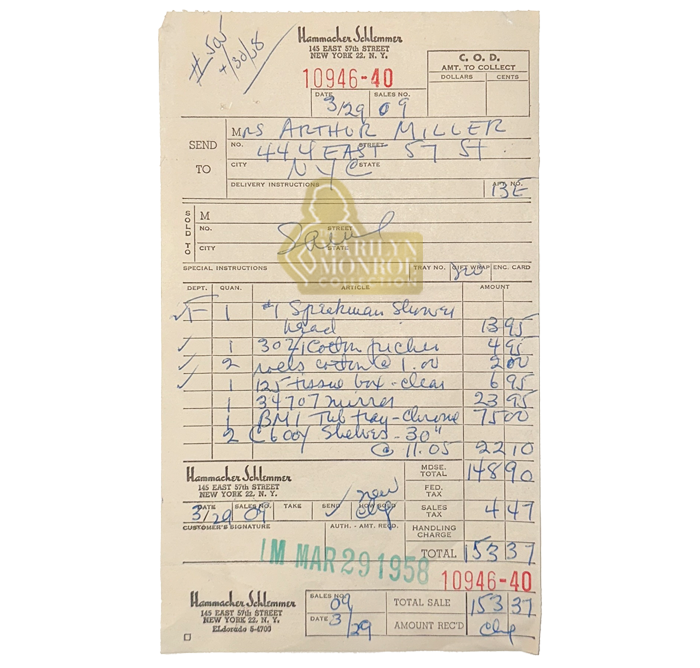
From the Personal Files of Marilyn Monroe: This original sales receipt from Hammacher Schlemmer in New York is dated March 29, 1958 and documents a series of household purchases made by Marilyn Monroe while she was living at 444 East 57th Street. The receipt is written out to “Mrs Arthur Miller,” reflecting the married name she used during her marriage to playwright Arthur Miller.
Hammacher Schlemmer, one of New York’s most established specialty retailers, was known for offering innovative household goods, practical conveniences, and distinctive lifestyle items. Monroe’s purchases listed on this receipt include a range of domestic products, among them kitchen and cleaning supplies, shelving components, and a clear tissue box.
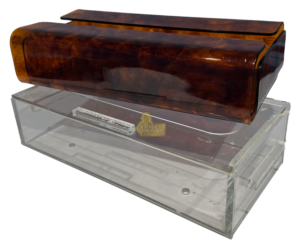
The inclusion of the clear tissue box is particularly notable. A matching clear tissue box from this period survives today within the collection, creating a rare and direct material connection between this administrative record and a surviving object from Monroe’s personal environment.
Preserved among her personal files, this document offers clear evidence of Monroe’s routine domestic purchases and the systems that supported her private life beyond the film set.
Receipts such as this provide precise documentation of Monroe’s daily life in New York during a period when she was actively balancing her personal life, acting studies, and professional commitments. Living in Manhattan with Arthur Miller, Monroe maintained a household that reflected both practical necessity and thoughtful attention to her surroundings.
Related Collection Artifacts:
Note: The tissue box referenced on the reciept is likely the same clear plastic tissue box in this collection.
Collector’s Note
What makes this receipt especially meaningful is the presence of the clear tissue box listed among the purchases. Objects like that were never intended to become historical artifacts. They were simply part of the fabric of daily living.
When a surviving object can be directly connected to a documented purchase, it transforms both the document and the object. The receipt becomes more than a record of a transaction. It becomes proof of presence. It confirms how Marilyn lived, what she chose to bring into her home, and how she shaped her personal environment.
This kind of documentation helps ground Marilyn Monroe’s story in verifiable detail. It reminds us that her life was not only lived on soundstages and in publicity photographs. It was also lived in apartments, shops, and ordinary moments that were rarely meant to be preserved.

Scott Fortner
Marilyn Monroe Collection
Founder & Owner

@mariylnmonroecollection 

TheMarilynMonroeCollection